Most Goals in Football History: Official Rankings and Records
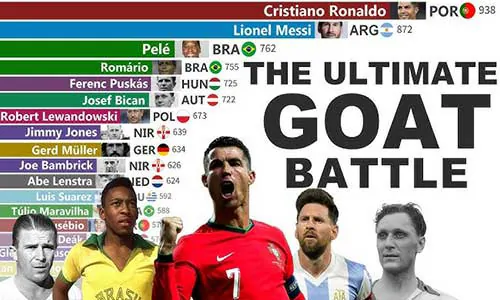
The debate over who has scored the most goals in football history is one of the most passionate and enduring discussions in the sporting world. Fans, statisticians, and historians continuously analyze career statistics to determine who stands at the absolute pinnacle of goalscoring greatness. In modern discussions, fans often look at Ballon d’Or Winners Ranked by their historical impact to add context to these massive goal tallies. Goals represent the ultimate currency on the pitch, and the pursuit of historic scoring milestones remains a source of endless fascination. Evaluating these records gives us a clearer picture of how the top Ballon d’Or Winners Ranked by goals compare.
Historically, tracking every single goal scored across different eras has proven to be a highly challenging task. While modern statistics are meticulously recorded, historical archives from the mid-20th century often feature conflicting reports and unverified match sheets. Consequently, organizations such as the Rec.Sport.Soccer Statistics Foundation (RSSSF) and the International Federation of Football History & Statistics (IFFHS) work diligently to establish definitive lists. In this comprehensive guide, we explore the official rankings, analyze the statistical methodologies, and look at how the greatest players of all time stack up against each other.
Table of Contents
- Understanding the Methodology: How Official Goals Are Counted
- Official Rankings of All-Time Top Goalscorers
- Ballon d’Or Winners Ranked by Career Goals
- The Active Legends: Cristiano Ronaldo and Lionel Messi
- The Historical Giants of Goalscoring
- Historical Controversies: Official vs. Unofficial Matches
- Frequently Asked Questions (FAQ)
- Conclusion: The Ultimate Footballing Legacy
Understanding the Methodology: How Official Goals Are Counted
To accurately determine who has scored the most goals in football history, we must first establish a reliable methodology. Different organizations use varying criteria, which explains why public lists often display conflicting numbers. For instance, some statistics include friendly matches, youth games, and amateur competitions, while others focus exclusively on top-level professional fixtures.
To ensure consistency, contemporary rankings rely on a framework that prioritizes “official matches.” According to the standard guidelines recognized by most modern statisticians, an official goal must meet the following criteria:
- First-Tier Club Matches: Goals scored in domestic leagues, domestic cups, and international club competitions at the highest professional level.
- Senior International Matches: Goals scored for senior national teams in official FIFA-recognized tournaments and friendlies.
- Exclusion of Unofficial Matches: Youth team games, reserve squad fixtures, training ground friendlies, and charity matches are excluded from the main competitive tally.
While legends like Pelé and Romário famously claimed to have surpassed the 1,000-goal milestone, those figures include hundreds of goals scored in exhibition matches and unofficial tournaments. By focusing strictly on top-level competitive fixtures, researchers can maintain a fair comparison across different eras. Additionally, we must recognize that the physical demands, defensive tactics, and number of fixtures played per season have shifted dramatically over the decades, making modern longevity even more remarkable.
Official Rankings of All-Time Top Goalscorers
The following table outlines the current standings of the most prolific goalscorers in the history of association football. These numbers reflect verified data from official senior-level matches for both club and country as of June 2026. Because active players continue to build on their totals, these rankings remain dynamic and subject to ongoing updates.
| Rank | Player | Country | Official Goals | Matches Played | Goal Ratio | Active Era |
|---|---|---|---|---|---|---|
| 1 | Cristiano Ronaldo | Portugal | 973 | 1,300+ | 0.74 | 2001–Present |
| 2 | Lionel Messi | Argentina | 911 | 1,150+ | 0.79 | 2003–Present |
| 3 | Josef Bican | Austria / Czechoslovakia | 805+ | 530+ | 1.52 | 1931–1955 |
| 4 | Pelé | Brazil | 762 | 840+ | 0.91 | 1956–1977 |
| 5 | Romário | Brazil | 755 | 970+ | 0.78 | 1985–2009 |
| 6 | Ferenc Puskás | Hungary / Spain | 746 | 750+ | 0.99 | 1943–1966 |
| 7 | Gerd Müller | West Germany | 735 | 790+ | 0.93 | 1962–1981 |
Ballon d’Or Winners Ranked by Career Goals
Individual accolades and goalscoring data are naturally intertwined. When looking at the list of Ballon d’Or Winners Ranked by their historical impact, it is fascinating to see how their scoring achievements reflect their standing in the sport. This perspective ensures that when we study Ballon d’Or Winners Ranked, we see their real impact on the pitch translated into the most important metric: goals. Crucially, many of the top ten goalscorers of all time also appear on the list of Ballon d’Or Winners Ranked for their individual brilliance.
For example, some of the most prolific goalscorers in the modern era have dominated the Ballon d’Or ceremony for more than a decade. The award, presented by French news magazine France Football, has historically favored players who combine world-class teamwork with astonishing individual output. Evaluating the careers of these iconic players highlights how elite goalscoring often translates directly into the highest level of individual recognition.
The Active Legends: Cristiano Ronaldo and Lionel Messi
In the modern era, Cristiano Ronaldo and Lionel Messi have shattered almost every pre-existing goalscoring record in the book. Their rivalry has pushed both players to unprecedented heights, and they remain the only active players to have scored over 900 official goals. Their achievements represent a unique era in the history of the sport, characterized by longevity, physical preparation, and tactical adaptability.
Cristiano Ronaldo: The Ultimate Goal Machine
Ronaldo’s career has been defined by his relentless work ethic and elite physical conditioning. Transitioning from a fleet-footed winger at Manchester United to a lethal, clinical central forward at Real Madrid, he became the most prolific goalscorer in the sport’s history. Ronaldo holds the record for the most goals in UEFA Champions League history, as well as the record for the most senior international goals in men’s football. His five Ballon d’Or trophies reflect his historical dominance across different European leagues.
Lionel Messi: The Genius Playmaker
On the other hand, Messi’s goalscoring output is accompanied by an equally legendary playmaking ability. Spending the majority of his career at Barcelona before moving to Paris Saint-Germain and Inter Miami, Messi has maintained an astonishing goal-to-game ratio. Despite operating in deeper tactical roles later in his career, his finishing remains incredibly precise. Messi’s record-breaking eight Ballon d’Or wins are a testament to his balanced style, which blends goalscoring, dribbling, and vision.
How Ballon d’Or Winners Ranked Shaped Modern Football Analytics
The dominance of these two active legends has completely transformed how modern football analytics evaluates elite players. Indeed, analyzing modern statistics shows how Ballon d’Or Winners Ranked historically maintain their goal-scoring standards even as physical demands increase. Furthermore, comparing active players gives us an evolving list of Ballon d’Or Winners Ranked in terms of efficiency, helping fans understand that scoring goals is only one facet of a player’s complete contribution on the pitch.
For instance, Cristiano Ronaldo and Lionel Messi are two Ballon d’Or Winners Ranked at the absolute peak of football excellence, but their styles differ fundamentally. While Ronaldo is a physical specimen who excels in aerial duels and off-the-ball movement, Messi utilizes low center of gravity, elite spatial awareness, and deceptive changes of pace. This is why, among all Ballon d’Or Winners Ranked, these two active legends are in a league of their own when it comes to long-term consistency.
The Historical Giants of Goalscoring
While the modern era has dominated the headlines, we must not overlook the incredible goalscoring feats of the pioneers who played in previous decades. These historical icons laid the foundation for modern tactics, and their scoring ratios often exceed those of today’s stars, albeit over fewer matches played due to the structure of football in the 20th century.
Josef Bican: The Pre-War Phenom
To understand the historical standard of elite goalscoring, one must look at Josef Bican. Playing primarily during the 1930s and 1940s, the Austrian-Czech forward possessed incredible speed and dual-footed shooting ability. He dominated European league football, particularly with Slavia Prague, where his goal-per-game ratio exceeded 1.5. Although some of his wartime records are difficult to verify, FIFA and the official FIFA website have recognized his historic status as one of the ultimate goalscoring figures of his century.
Pelé: The Eternal King
Pelé remains one of the most culturally significant sports figures in global history. A three-time World Cup winner with Brazil, Pelé combined athleticism, technical mastery, and clinical finishing. While his overall tally of 1,283 goals includes various unofficial tour matches with Santos, his official competitive record of 762 goals stands as a monumental achievement, especially considering he played in an era of highly physical and often unprotected defending.
Romário: The Penalty Box Specialist
Romário was a master of evasion and short-burst acceleration inside the penalty area. His career spanned multiple decades and saw him find success in Brazil, the Netherlands, and Spain. Known for his cold-blooded composure in front of goal, Romário officially registered 755 competitive goals, cementing his place in the upper echelons of Brazilian and global football history.
Ferenc Puskás: The Galloping Major
As the talisman of the legendary Hungarian “Mighty Magyars” of the 1950s and later a cornerstone of Real Madrid’s early European dominance, Ferenc Puskás possessed one of the most lethal left feet in football history. His tactical intelligence and precise ball control allowed him to score 746 official goals in just over 750 matches, achieving an almost perfect 1:1 goal-to-game ratio over his professional career.
The Legacy of Ballon d’Or Winners Ranked in Soccer History
Looking back, the history of the sport is filled with Ballon d’Or Winners Ranked by their clinical finishing. Consequently, the debate about who represents the ultimate peak of the sport often shifts from raw goal tallies to individual efficiency. Additionally, legendary figures like Gerd Müller show why Ballon d’Or Winners Ranked by efficiency remain so respected. Müller, known as “Der Bomber,” scored 735 official goals with an astonishing goal-per-game ratio, proving that positioning and reaction speed are just as vital as physical power.
It is no surprise that when we see these Ballon d’Or Winners Ranked, their goal-to-game ratios are unmatched by all but the very elite. Consequently, any debate about the greatest of all time will always feature Ballon d’Or Winners Ranked by their official goals. For example, Johan Cruyff, Marco van Basten, and Eusebio may not have reached the 900-goal mark, but their tactical influence combined with elite scoring made them legends of their respective eras. Ultimately, looking at Ballon d’Or Winners Ranked helps us appreciate the scale of their achievements and the standards required to win the sport’s most prestigious individual award.
When the final numbers are tallied, the list of Ballon d’Or Winners Ranked serves as a Hall of Fame for goalscorers. It highlights how consistent, high-level scoring in major tournaments like the UEFA Champions League, the European Championship, and the Copa América is often the catalyst for individual glory. In conclusion, looking at the Ballon d’Or Winners Ranked side-by-side with official goal records offers deep insights into the evolution of football over the past century.
Historical Controversies: Official vs. Unofficial Matches
One of the primary reasons for the ongoing debates in football rankings is the discrepancy between official and unofficial matches. In the mid-20th century, European and South American clubs frequently traveled across the globe to play high-profile exhibition matches. These tours had immense cultural prestige, and matches against top international opponents were highly competitive. However, modern statistical standards classify these as friendlies, excluding them from official career totals.
Pelé’s club, Santos, regularly opted to play lucrative international friendlies rather than participating in continental competitive tournaments. Similarly, Josef Bican’s career occurred during a period of geopolitical instability, meaning several of his league seasons took place in regional, wartime leagues whose official status is still debated by historians. Consequently, while we rely on verified competitive numbers for modern comparisons, we must respect the context of the historical eras in which these legends played.
Frequently Asked Questions (FAQ)
1. Who has scored the most official goals in football history?
As of June 2026, Cristiano Ronaldo holds the official record for the most goals in football history, with over 970 verified goals for club and country in competitive matches. He is followed closely by Lionel Messi, who has scored over 910 official goals.
2. Why are Pelé’s 1,283 goals not officially recognized by FIFA?
Pelé’s famous tally of 1,283 goals includes matches played in youth competitions, military leagues, and unofficial club friendlies. While those matches were highly competitive at the time, modern statistical bodies like RSSSF and FIFA only count goals scored in official, top-level competitive club and senior international matches, placing his official total at 762.
3. Are all the top goalscorers also found on the list of Ballon d’Or Winners Ranked?
Yes, many of the highest goalscorers are indeed the top Ballon d’Or Winners Ranked by overall career achievements. Players like Cristiano Ronaldo, Lionel Messi, and Gerd Müller have won multiple Ballons d’Or, illustrating the close link between elite goalscoring and individual accolades.
4. What constitutes an “official goal” in modern football?
An official goal is one scored in a match organized by a national association, continental confederation, or FIFA. This includes domestic top-flight leagues, official cup competitions, continental tournaments (like the Champions League), and senior-level national team matches. Club friendlies and pre-season tournaments are excluded.
5. Who has the best goal-to-game ratio in football history?
Among the top-ranked goalscorers, Josef Bican holds the most impressive goal-to-game ratio, averaging approximately 1.52 goals per match over his career. Fernando Peyroteo, a legendary Portuguese forward, also boasts an elite ratio, though he played fewer total matches than Bican.
6. Can Lionel Messi surpass Cristiano Ronaldo’s all-time goal record?
While Messi is younger than Ronaldo and has played fewer matches, both players are still active and continuing to add to their totals. The final outcome of the race will depend heavily on how long each player continues their professional career and their physical durability in their respective leagues.
Conclusion: The Ultimate Footballing Legacy
Ultimately, the race for the most goals in football history is more than just a battle of numbers; it is a celebration of longevity, elite skill, and athletic consistency. Whether one favors the sheer physical output of Cristiano Ronaldo, the creative playmaking of Lionel Messi, or the historical dominance of Josef Bican and Pelé, there is no denying that these players have defined the sport. As football continues to evolve, these legendary records serve as a benchmark for future generations of attackers striving to make their mark on the beautiful game.